What Is Domain Authority and How Is It Calculated?
What is Domain Authority and how is it calculated? Learn how Moz's DA score works, what a good score looks like, and 6 proven ways to improve it.
Your competitor publishes a blog post on the same topic as yours. Your content is better researched, better written, and published a week earlier — yet their page outranks yours on Google. One of the most common culprits: their website carries more authority than yours.
Domain Authority (DA) is the metric that tries to measure exactly that authority gap. Understanding how it works, how it's calculated, and — most importantly — how to improve it gives you a clearer roadmap for closing the gap with competitors in organic search.
What Is Domain Authority (DA)?
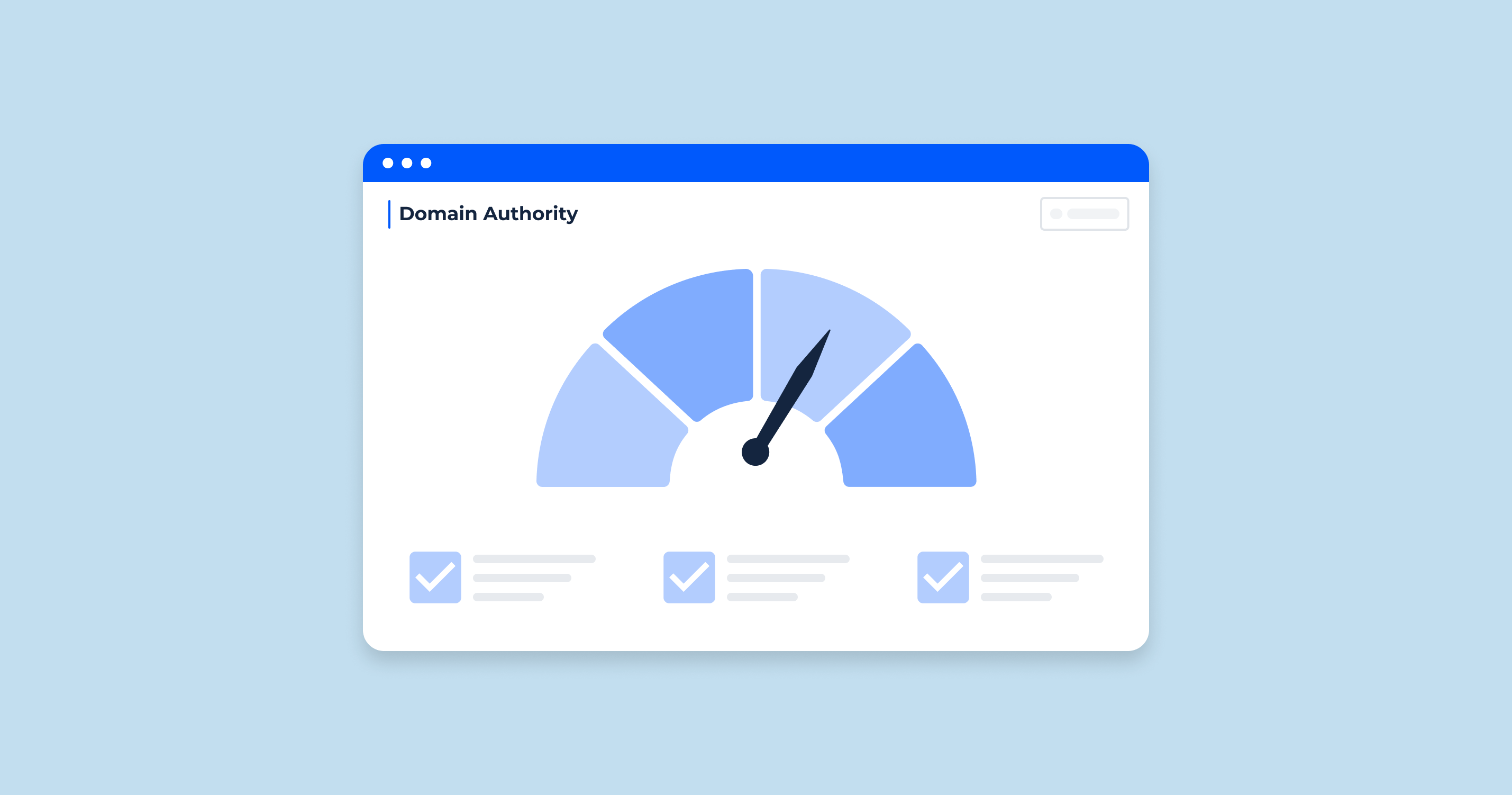
Domain Authority is a search engine ranking score developed by Moz, a leading SEO software company. It predicts how likely a website is to rank in search engine results pages (SERPs) compared to other domains. The scale runs from 1 to 100 — the higher the score, the stronger the predicted ranking potential.
A few key facts to internalize from the start:
- DA is not a Google ranking factor. Google does not use it directly in its algorithm.
- It is a comparative metric, not an absolute one. A DA of 40 is excellent if your competitors average DA 25 — and weak if they average DA 65.
- DA is a third-party prediction by Moz, updated regularly as the web's link landscape shifts.
Think of DA the way many SEO professionals do: like a credit score. Banks don't look at your FICO number directly, but they examine the same underlying signals. Similarly, Google doesn't use DA, but it evaluates domain trust and authority in its own way — and the two systems are looking at largely the same things.
New websites start at DA 1 and build from there. Major platforms like Facebook, Amazon, and YouTube sit near DA 100. Most successful business websites and established blogs land somewhere between DA 30 and DA 70.
How Is Domain Authority Calculated?
Moz calculates Domain Authority using a machine learning algorithm that weighs over 40 signals, then plots the result on a logarithmic scale from 1 to 100. The algorithm has been updated multiple times since its introduction, with Domain Authority 2.0 (released in 2019) adding spam detection and real Google SERP data into the mix.
The core factors Moz evaluates include:
1. Linking Root Domains (the most important factor)
This is the count of unique websites that link to your domain. One hundred backlinks from a single site still count as just one root domain. Moz — and Google — heavily favor link diversity. A backlink profile with 500 links from 500 different domains carries far more authority than 5,000 links from 5 domains.
2. Total Number of Backlinks
Alongside root domain diversity, the raw volume of inbound links matters. More backlinks generally signal higher trust, but only if they come from reputable sources.
3. Link Quality (MozRank and MozTrust)
Not all links are equal. A single backlink from a high-authority news site can carry more weight than dozens of links from obscure blogs. Moz evaluates both the authority of the linking page (MozRank) and its trustworthiness (MozTrust).
4. Spam Score
Moz calculates a spam indicator for each domain. Sites with backlinks from spammy or low-quality sources receive a higher spam score, which drags down DA. Buying bulk backlinks or participating in link farms actively hurts your score.
5. The Logarithmic Scale
This is the detail most site owners miss. Because DA uses a logarithmic scale, early gains are relatively easy but progress slows dramatically as you climb higher. Moving from DA 10 to DA 20 is significantly easier than moving from DA 60 to DA 70. At the top end of the scale, even the world's largest websites struggle to push the needle. This is why you should never compare your DA to sites like Wikipedia — focus on your direct competitors instead.
What Is a Good Domain Authority Score?
There is no single "good" DA score. The right benchmark depends entirely on your industry and the specific competitors you're trying to outrank. That said, here is a general reference framework:
| DA Range | What It Typically Means |
|---|---|
| 1–20 | New websites or sites with minimal backlink profiles |
| 20–40 | Established sites with moderate link acquisition |
| 40–60 | Well-established businesses, popular blogs, regional authorities |
| 60–80 | Major publications, large corporations, highly authoritative sites |
| 80–100 | Global brands: Amazon, Wikipedia, Facebook, YouTube |
Sites with DA 50 or higher are nearly 3.7 times more likely to rank in the top 10 for competitive keywords than sites with DA 20–30, according to a Ranktracker analysis of search results. That said, a site with DA 17 can still outrank a DA 46 site for the right keyword — because DA is a site-wide signal, and keyword relevance, content quality, and on-page SEO also matter enormously.
The practical advice: run a competitor analysis first. Use a DA checker tool, plug in your five closest organic competitors, and find the average. That average becomes your realistic target — not an arbitrary number you read in a blog post.
Domain Authority vs. Page Authority: What's the Difference?
Domain Authority measures the ranking strength of your entire website — the full domain.
Page Authority (PA) measures the ranking strength of a single, specific page on any website.
Both use the same 1–100 logarithmic scale and both are primarily driven by backlinks. The key difference is scope:
- DA reflects every backlink pointing anywhere on your domain.
- PA reflects backlinks pointing to that specific URL, plus the internal links from other pages on your site.
A practical example: you might publish a data-driven report that attracts thousands of backlinks. That page's PA could be significantly higher than your site's overall DA — and it can rank strongly for its target keyword even if the domain itself isn't highly authoritative.
The two metrics also influence each other. As you build high-PA pages through targeted link earning, your overall DA climbs. Conversely, a high-DA domain automatically passes some authority to every new page you publish — which is why established sites can rank new content faster than brand-new websites.
Use DA when evaluating your website's competitive position overall. Use PA when diagnosing why a specific page isn't ranking — and which pages need more targeted backlink support.
DA vs. Ahrefs DR vs. Semrush Authority Score
Moz's DA is the original authority metric, but it is far from the only one. Here is how the three major tools compare:
Moz Domain Authority (DA)
Uses a machine learning model trained on over 40 factors including backlinks, root domains, and spam indicators. Correlates with Google SERPs. Best for: benchmarking against competitors, evaluating link-building progress over time.
Ahrefs Domain Rating (DR)
Focuses almost exclusively on the backlink profile — specifically the number and quality of unique referring domains. Ahrefs studied 218,713 domains and found a strong correlation between DR and keyword rankings. Best for: evaluating raw backlink strength and identifying link opportunities.
Semrush Authority Score (AS)
Incorporates not just backlinks but also organic traffic data and website health signals. Provides a broader picture of overall domain credibility. Best for: agencies that want a single composite score across multiple SEO dimensions.
All three metrics agree on one thing: they are not Google ranking factors, but they all measure signals that Google does evaluate. The most important rule: pick one tool and track it consistently. Switching between tools month to month introduces misleading fluctuations because each tool uses its own data index and calculation methodology.
How to Check Your Domain Authority
Checking your DA takes less than a minute. Several free tools are available:
WmTools DA PA Checker — wmtools.me/da-pa-checker
Instantly checks Domain Authority, Page Authority, Spam Score, domain age, and IP address for any URL. No signup required. Supports bulk checking of multiple domains at once — ideal for running competitor analysis side by side. One of the fastest ways to get an accurate DA picture in a single click.
Moz Link Explorer — moz.com/link-explorer
The original source of DA data. Provides the most detailed breakdown of linking root domains, top backlinks, and spam score alongside the DA score itself.
Ahrefs Website Authority Checker — ahrefs.com/website-authority-checker
Returns Domain Rating alongside referring domains, total backlinks, and the site's top 100 backlinks. Best paired with Ahrefs' full suite for deep link analysis.
A practical tip: track your DA monthly or quarterly, not daily. The metric does not update in real time, and short-term fluctuations are normal. What you want to see is an upward trend over a 3–6 month period that confirms your link-building strategy is working.
How to Improve Your Domain Authority: 6 Proven Strategies
Improving DA is a long-term investment, not a quick fix. Moving from DA 20 to DA 40 typically takes months of consistent, strategic work. Here are the six strategies that move the needle most reliably.
1. Earn High-Quality Backlinks From Relevant Domains
This is the single most impactful lever. Pages with more than 100 backlinks receive 3.2 times more organic traffic than pages with fewer links, according to Ahrefs' analysis of one billion pages. The emphasis is on quality and relevance, not raw volume.
Effective approaches:
- Guest posting on reputable sites in your niche (used by 64.9% of link builders, according to Authority Hacker)
- Digital PR: publish original research, surveys, or data reports that journalists and bloggers will cite
- Broken link building: find broken links on relevant sites and offer your content as a replacement
- Resource page outreach: identify curated resource lists in your industry and request inclusion
One backlink from a trusted, relevant domain outperforms dozens from unrelated or low-quality sites. Prioritize relevance above all else.
2. Diversify Your Referring Domains
Remember: 100 backlinks from one website count as one root domain. Your goal is to earn backlinks from as many different, high-quality domains as possible. Actively monitor your backlink profile in a tool like WmTools DA PA Checker, Moz, or Ahrefs to ensure you're building genuine diversity.
B2B companies with 500 or more referring domains see roughly 34% more organic traffic than those with smaller link profiles, according to industry benchmark data.
3. Audit and Remove Toxic Backlinks
Spammy or low-quality backlinks actively drag your DA down. Run a regular backlink audit — quarterly is a good cadence — and identify links with high spam scores. You have two options for removing harmful links:
- Contact the referring site's webmaster and request removal.
- Use Google Search Console's Disavow Tool to tell Google to ignore specific links.
Cleaning up a toxic backlink profile can produce noticeable DA improvements within Moz's next index refresh.
4. Strengthen Your Internal Linking Structure
Internal links distribute authority across your site. A high-authority page that receives many external backlinks can pass some of that authority to newer or lower-authority pages through strategic internal linking. This is one of the most underrated DA improvement tactics.
Best practices:
- Use descriptive, keyword-relevant anchor text for internal links.
- Ensure your most important pages (product pages, pillar content) receive the most internal links.
- Fix any broken internal links — they leak authority and frustrate users.
5. Publish High-Quality, Link-Worthy Content Consistently
Content that is original, well-researched, and genuinely useful attracts backlinks naturally. Think: original data, comprehensive guides, visual resources (infographics, charts), and expert roundups. These content formats earn links because other sites want to reference them.
This is especially important in the current search environment. Google's March 2024 core update cracked down heavily on thin or AI-generated content, rewarding sites that publish substantive, experience-backed material. High-quality content not only earns links — it improves your on-page SEO signals, which Moz's DA 2.0 algorithm also factors in.
6. Fix Technical SEO Issues
Technical problems do not directly lower your DA score, but they can suppress your Google rankings — and if your rankings fall, you earn fewer organic links over time, which indirectly hurts DA. Technical issues to address:
- Page speed and Core Web Vitals (Largest Contentful Paint under 2.5 seconds)
- Mobile-friendliness (Google uses mobile-first indexing)
- HTTPS / SSL security
- Broken links and crawl errors
- Clean URL structure and proper sitemaps
A site that Google can crawl efficiently, loads fast, and provides a strong user experience builds authority more sustainably than one with a strong backlink profile but poor technical health.
Common Mistakes That Hurt Your DA Score
Understanding what not to do is just as important as knowing what to do.
Buying bulk backlinks or using link farms. Moz's DA 2.0 algorithm specifically targets link spam patterns. Sites engaged in link schemes typically see DA drops — and the risk of a Google manual penalty is real. One quality backlink earns more than a thousand spammy ones.
Getting multiple links from the same domain. A single referring domain counts once toward your root domain total, no matter how many pages on that domain link to you. Diversifying your link sources always beats stacking links from one site.
Ignoring Spam Score. Many site owners focus exclusively on acquiring links and never audit what they already have. A growing backlink profile full of low-quality links can stall your DA or push it down, even as your total link count rises.
Chasing DA as an end goal. DA is a directional indicator, not a business objective. A site with DA 35 and great content targeting low-competition keywords will outperform a DA 60 site with poor content. Use DA as one data point within a broader SEO strategy.
Comparing your DA to non-competitors. Benchmarking your DA against Wikipedia or Amazon is meaningless. The only meaningful comparison is against the sites competing with you for the same keywords.
Conclusion
Domain Authority is one of the most useful benchmarks in SEO — as long as you treat it correctly: as a comparative, directional metric rather than an absolute score or a Google ranking factor.
The path to a higher DA runs through the same fundamentals that drive search rankings more broadly: earning high-quality backlinks from diverse, relevant domains, publishing genuinely useful content, maintaining a clean backlink profile, and keeping your site technically healthy.
Start by establishing your baseline. Use the WmTools DA PA Checker to check your current DA alongside your top five competitors. That comparison will show you exactly how large the authority gap is — and give you a clear, prioritized starting point for closing it.
Authority is built over months and years, not days. Begin the work now, and let the score follow.
Frequently Asked Questions
Is Domain Authority a Google ranking factor?
No. Google does not use Domain Authority in its algorithm. DA is a third-party metric created by Moz. However, the signals that raise DA — quality backlinks, strong content, trustworthy referring domains — closely mirror what Google evaluates, so improving your DA typically correlates with better rankings.
What is a good Domain Authority score?
There is no single "good" DA score. It depends entirely on your niche and competitors. If your competitors average DA 30, a score of 35 is competitive. Always benchmark your DA against direct competitors, not against authoritative sites like Wikipedia or Amazon.
How often does Domain Authority update?
Moz updates Domain Authority scores regularly as it recrawls the web and refreshes its link index. Scores can fluctuate even if you haven't made changes to your site, because the metric is relative — if competitors gain strong backlinks, your score may dip.
What is the difference between Domain Authority and Domain Rating?
Domain Authority (DA) is Moz's metric. Domain Rating (DR) is Ahrefs' equivalent. Both predict ranking potential based on backlink profiles, but they use different data sources and algorithms. Pick one tool and track it consistently for accurate trend analysis.
Can I increase my Domain Authority quickly?
No. Legitimate DA growth takes months of consistent effort — earning quality backlinks, publishing strong content, and fixing technical SEO issues. Sudden spikes from link schemes or paid link farms are typically penalized and can cause long-term drops.